.png)

As physicians, we make dozens of clinical decisions during a patient encounter. We assess problems, review data, weigh risk, and decide on a course of treatment. Then, at some point, we have to translate all of that work into a five-digit billing code.
We’ve all done the mental math. How many problems did we address? What data did I review? Did prescription drug management change the level of complexity? If I wasn’t completely confident, there was always an incentive to be conservative. The possibility of an audit and having to defend a coding decision later tends to make physicians cautious.
None of that changes the care I delivered. It is an administrative reconstruction of the clinical thinking that already happened. And that reconstruction is where accuracy can start to break down.
The Note Is the Ceiling
We all know that a complex patient doesn’t necessarily mean a complex E/M code. What matters is the medical decision-making documented during that specific encounter.
A patient can have multiple chronic conditions and a complicated medical history, but if today’s visit focuses on one straightforward acute problem, the coding should reflect the work performed during that visit. The inverse is also true. A relatively short visit can involve moderate complexity based on the problems addressed, data reviewed, and management decisions made.
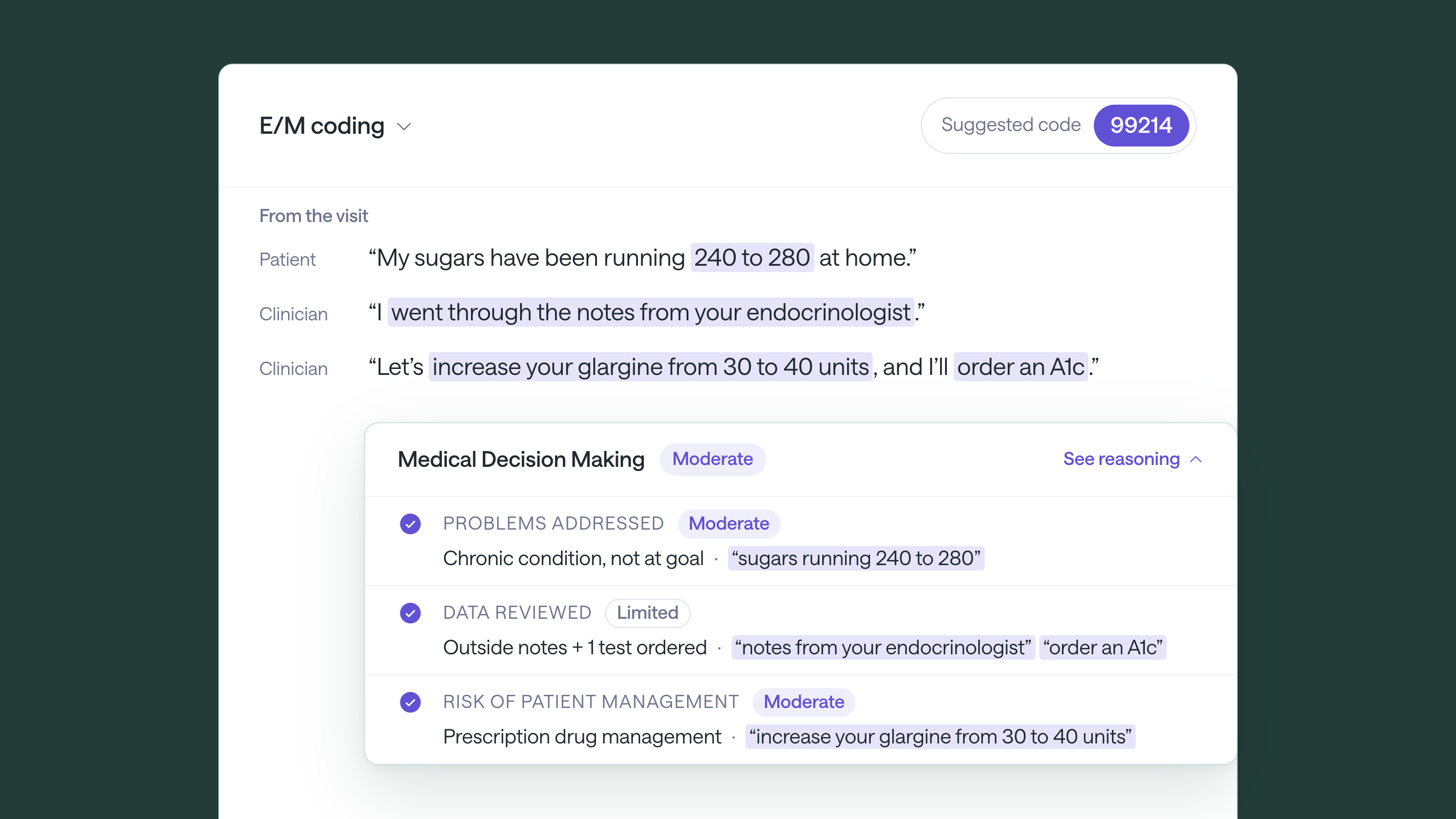
Since changes to office and outpatient E/M coding took effect in 2021, medical decision-making is evaluated across three areas: the number and complexity of problems addressed, the amount and complexity of data reviewed and analyzed, and the risk associated with patient management. Two of those three elements must support the level billed.
The important distinction is that a coder cannot reconstruct clinical reasoning that never made it into the record. If I reviewed outside data but didn’t document it, or managed a chronic condition without clearly capturing its status, that work may not be reflected in the final code.
In other words, the note is the ceiling. Coding can only reflect what the documentation supports.
The Problem With Reconstructing Clinical Thinking
The current system creates an interesting problem for physicians because the clinical reasoning happens in the room, while coding often happens later.
During a typical clinic session, I might see eight patients before I sit down to finish notes and submit charges. Most physicians know this experience well: looking back across multiple encounters and trying to reconstruct the details that determined the complexity of each visit.
That process introduces unnecessary cognitive work. I know what happened clinically, but now I have to translate it into a coding framework that most of us were never formally taught. The old workflow meant mentally counting the problems addressed, outside notes reviewed, tests ordered, and other factors that contribute to medical decision-making.
There are downstream systems designed to catch documentation gaps, but they face the same fundamental limitation. A coder can review what I wrote. A CDI team can identify missing specificity and send me a query. Neither can independently add clinical reasoning that I didn’t document in the first place.
The most accurate opportunity to capture that reasoning is when it happens.
Accuracy, Not Higher Coding
This distinction matters because the goal of AI-assisted coding should never be to push physicians toward higher codes. The goal is accuracy.
Sometimes a visit feels complex because the patient is complex, but the actual work performed during that encounter was relatively straightforward. Other times, a short encounter includes enough clinical decision-making to support a higher level than the physician might intuitively assign.
I've experienced both in my own practice. What gives me confidence isn't simply seeing a suggested E/M level. It's being able to see the reasoning behind it: the conditions addressed, the data reviewed, and the management decisions that contributed to the recommendation. I can quickly confirm that the logic reflects what actually happened rather than relying on how difficult the encounter felt or what I remember several hours later.
That transparency is important. Physicians shouldn't have to trust a black box with coding decisions. We should be able to understand why a recommendation was made and determine whether it accurately represents the care we provided.
Removing Another Administrative Burden
This was a challenge I wanted to tackle at Nabla. Ambient documentation had already addressed one significant source of administrative work by reducing the effort required to turn a patient conversation into a clinical note. But documentation is only one of the administrative tasks surrounding an encounter. Coding is another.
It’s a problem I still encounter in my own clinic, and one we wanted to approach differently at Nabla: how could we make that mental math simpler, more transparent, and more accurate without taking the clinician out of the decision? With E/M coding, that meant asking how we could take the mental math physicians do every day and make it simpler, more transparent, and more accurate without taking the clinician out of the decision.
Today, instead of starting from scratch and doing that mental math myself, I can review the suggested code, check the reasoning behind it, and move on. The difference sounds small, but across a full clinic day, removing another repetitive administrative calculation matters. And the goal is much bigger than improving my own workflow. It’s about solving this problem in a way that can give thousands of clinicians that same confidence while helping healthcare organizations improve the accuracy and consistency of documentation at scale.
That's increasingly how I think about the role of clinical AI. The opportunity isn't limited to generating a better note. It's identifying the administrative work surrounding patient care that technology can handle more accurately and efficiently, while keeping the clinician in control.
I didn't go to medical school to memorize five-digit billing codes. I went to medical school to take care of patients. The more of these administrative tasks we can make simpler, more transparent, and more accurate, the more attention we can return to the work that brought us into medicine in the first place.
Learn how Nabla brings coding intelligence directly into the note.