
Margaux Benoit is an Enterprise Sales Director at Nabla, where she was the company's first US commercial hire and has grown its enterprise go-to-market efforts in the ambient AI clinical documentation space. She works with major health systems across the US. With a background in business at X-HEC and bioscience entrepreneurship at UCL, she is passionate about supporting health systems move past pilot fatigue and deploy AI that actually holds up in day-to-day clinical practice.
A few years ago, the question health systems asked was whether to adopt ambient AI documentation at all. That question is mostly settled. Walk into most large systems today and you will find an ambient scribe already deployed, often one of the big first-generation tools. The category is no longer new.
So the real questions have changed. Is it actually adopted, or did usage spike at go-live and then plateau? Is it driving measurable impact, or just sitting in the EHR? And does it cover everyone who documents, or only the physicians it was originally built for? If you are evaluating ambient AI in 2026, you are almost certainly evaluating it against something you already own. That changes what you should be looking for.
Having it is not the same as using it
Adoption is where most first-generation deployments quietly stall. A tool gets rolled out, the early adopters love it, and then the curve flattens. The clinicians who needed it most are often the ones who churn first, because the output was not quite good enough for their workflow and nobody followed up.
This matters for rev cycle specifically, because the financial case only materializes at scale. Better documentation improves coding accuracy, E/M capture, and clean claim rates only when a real share of your clinicians are using the tool consistently and trusting what it produces. A deployment stuck at 30 percent active use is not a revenue integrity story. It is a line item.
The coverage gap nobody talks about
First-generation ambient tools were built for a specific picture: a physician in a fairly standard visit. They do that reasonably well. They tend to fall short everywhere else.
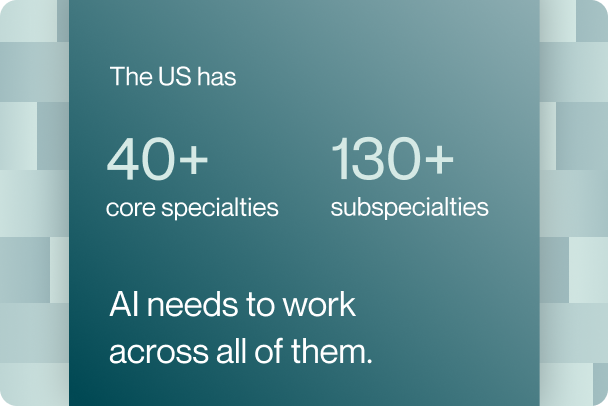
Think about who else documents in your system and carries a heavy charting burden. Social workers. Case managers. Behavioral health. Complex, multi-problem specialty encounters. These are some of the hardest documentation jobs in the building, often with real compliance and reimbursement stakes, and they are exactly where the first wave of tools is weakest. If your incumbent only serves a slice of your clinicians, you are leaving both burden and value on the table.
So the question in any 2026 evaluation is not "does it work for a primary care visit." It is "does it work for the roles my current tool left behind." That gap is precisely where Nabla focuses, building for the specialties and roles that first-generation tools underserve.
Nabla has rolled out to more than 15,000 non-physician roles precisely: case managers, social workers, BH clinicians, NPs are now generating structured, reviewable documentation from conversations that used to be captured after the fact. Our platform architecture supports broad specialty and role customization, with specific model training on the backend tuned to the language, structure, and cadence of these specific conversations.
Adoption is a partnership problem, not a product problem
Here is the thing a demo will never show you. The best adoption does not come from the best model. It comes from the best hand-holding.
Selling into a health system is not a done deal when the contract is signed. The hardest work is the relationship building that gets you there, and then an equally hard and equally important phase right after: implementation, and a tailored partnership between the vendor's customer success and sales teams and the people who actually run the system. The clinical managers. The CMIOs and CIOs. The frontline clinicians and the administrative staff doing the documentation every single day. Adoption is earned in that layer, person by person and workflow by workflow.
A vendor that disappears after go-live will hand you a deployment. A vendor that stays close, tunes for your specialties, and works shoulder to shoulder with your teams will help you build adoption. And adoption is what produces the rev cycle impact you signed up for in the first place.
What partnering deeply actually looks like
The word "partnership" gets used loosely in this category, so it helps to define it by what you can actually observe after the signature.
They share your metrics, not just their own. A partner asks about your denial rates, your coding accuracy, and your clinician retention, and ties their work to the numbers your CFO and CMIO care about.
They put named people on your account. You should know your clinical lead, your integration contact, and who you call when something breaks at 7 am before clinic. Named and consistent beats a ticket queue every time.
They co-build for your specialties and your harder-to-serve roles. Cardiology does not document like behavioral health, and a case manager does not document like a surgeon. Your edge cases are the work, not an excuse.
They show up on a cadence. Business reviews are where you catch adoption dips early, expand to the next service line, and decide together what to fix next.
They are willing to be measured. The vendors worth signing will put success criteria, or even fees, at risk, because they are confident enough to.
Client voices:
"The implementation of Nabla highly contributed to our observation of reduced chart closure time from 24 days to 10 days (a 60% drop) year-over-year, with Nabla as a key contributing initiative.” Dr Crichlow, Codman Health Square Center
"One of the best things about working with Nabla has been their responsiveness. Every time I submit feedback, I get real responses and updates in real time," Dr. Whitling, CMIO, Boulder Health System
"It is a total game changer; it has made my conversations with members much more enjoyable...I love it!” Care Manager user of Nabla, CVS Health
If you already have ambient AI, your next evaluation is not really about whether the technology works. It is about whether yours is genuinely adopted, whether it reaches everyone who documents, and whether your vendor is a real partner or just a logo on a contract. The systems getting real impact are not the ones who picked the flashiest demo. They are the ones whose vendor kept showing up every day after the ink dried.